Big Walk, AI Usage and Trust as Commodity
Spoilers for Big Walk.
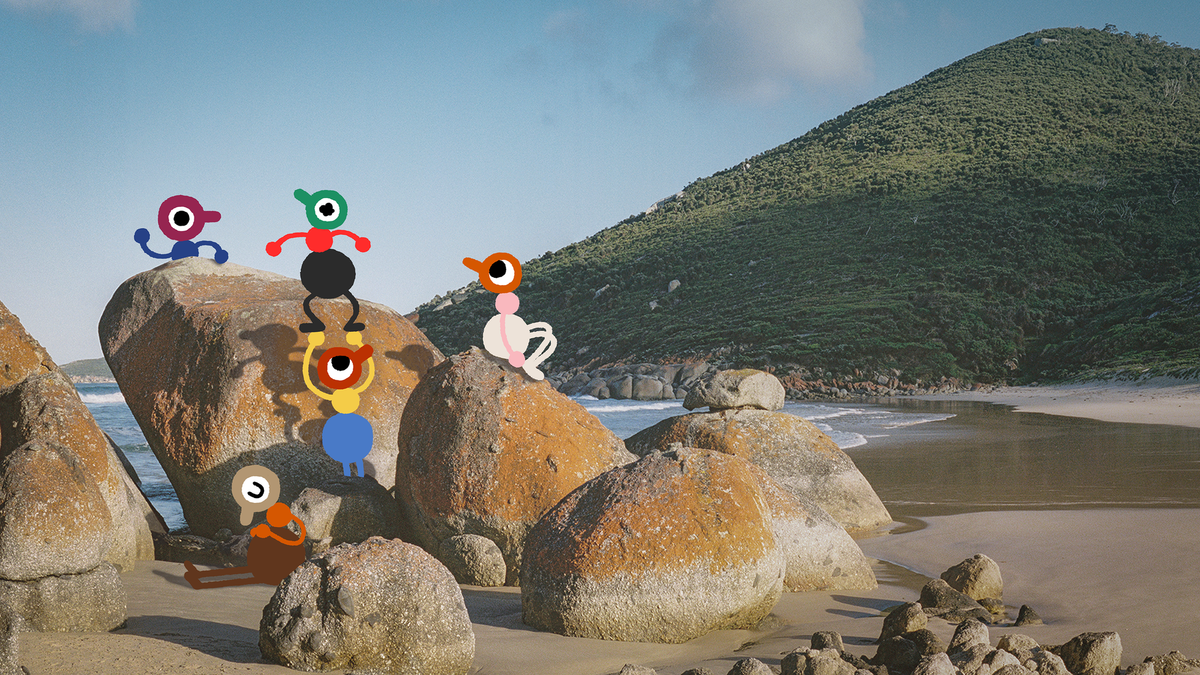
Big Walk, like all art, is about the process of creating. Stranded on an island with a group of peers, friends, lovers, you wander in search of puzzles and keys to unlock more of the island. With each puzzle, the game teaches you more and more how to communicate in ways that go beyond the verbal. A lift of the arms, an awkward jump, a shake of the head, a knowing look. The game’s final stretch of puzzles removes the players’ ability to talk, and after a brief burst of panic, you each realise you have already been taught to communicate without a traditional vocabulary; now, you speak in the language of game design, of an instinctive method of artistic expression in which those around you innately understand what you mean and what needs to be done. You each evaluate the problems before you, you wordlessly work towards solutions, and you overcome them.
This is Big Walk’s surprisingly grand statement: in the same way developer House House built the game, in the ways they found to communicate and express their complex artistic ideas to one another, players learn to express themselves in similarly creative and problem solving ways. There is real empathy and synchronicity here, in which it is revealed not only have you been in dialogue with those in your game, but also the developers themselves. It’s an act of slow, earned trust between player and developer, a reflective surface upon which rests the goodness of human expression and creativity.
Our lives are a sequence of compromises and inconsistencies. Unless we want to move to cabins in rural Montana and write manifestos, we accept (or try and justify) the imperfectness of our choices. That we are forced to engage with elements of capital which are unsavoury and unethical is not an excuse to not make better choices, and it is also not an excuse to reduce those choices solely down to acts of consumerism. Independent games, and independent art in general, occupy a space in which the relationship of trust between audience and creator is assumed to be much stronger than the relationship to art created within corporate bounds. That trust is through an assumption of shared values: that to pursue independent art, while still bound to commerce, is an act of escape from the capitalist and hegemonic norms that bind corporate art. Think of how many inspiring stories we’ve read of developers who once worked in massive, AAA teams, who finally break out on their own to make small, dream projects. Whether art made with one hundred dollars or one hundred million dollars is better is not the point, it’s that the one hundred dollar art is seen as a response and a rejection to commercialised, corporate art.
This is why it is, in fact, a bigger deal for House House to use and not disclose Generative AI rather than a multibillion dollar publisher. There is a level of acceptance that large corporate entities will be less discriminate in how they produce art; whether that acceptance is enough for the audience to overlook the usage or reject the art is going to be individualised. Meanwhile, Big Walk’s philosophy is inclusive, not in the social justice sense, but in its design philosophy. The group of players are as much an architect of the experience as the developers, partaking in a recreation of what it’s like to build a video game. Each puzzle is a new technical challenge, each person wandering off (and oh, there is much wandering off) is exploring new and untapped ideas, every argument about why I dropped the only compass down a ravine is mean and hurts my feelings. Even the true ending feels like a post-mortem debrief at the end of a big project, in which you share the challenges you experienced and how you overcame them. Big Walk invests the player into not only the experiential playing of the game, but of the process of games and creation itself.
And so, the undisclosed AI usage is disappointing, to say the least. One of capital’s grandest projects within the 21stcentury has been to devalue art and the labour with which it takes to make art. Generative AI is capital’s siege machine in its newest, most up to date guise, a behemoth of chrome and polluting smoke that insists upon its own inevitability. To avoid AI means to be crushed beneath the siege engine rather than embracing its roaring, destructive power; everyone else is on board, why bother to hide behind the fragility of your walls? Do you want to be left behind in the ruins?
This is, of course, facile. Capitalism’s most insidious messaging has always been proclaiming its own inevitability, advocating for itself not as the best or most humanising system, but the only sensible one. Yet for something so apparently inevitable, to capitulate to it is still a point of shame. House House are not indiscrete in their politics. They have refused to publish the game on Xbox platforms, in accordance with the BDS boycott, and the game’s credits end with a land acknowledgement to the Wurundjeri people, on whose land the game’s island is based. This is a studio who is conscious of their messaging. But in regards to generative AI, they chose not to message at all. For a game that insists that communication is part of what makes us innately human, the developers themselves seem to have been quite calculating in how their AI usage has been communicated.
Take, for example, House House’s one provided piece of evidence being a technical problem involving the need ‘to cull shadow casters by distance from the camera’. On the surface, this reads as inevitable, even necessary, usage. An unsolvable problem, worked through only with the application of AI tools. Yet, it’s the only example provided. Does that mean every implementation of AI code was for an unsolvable problem? Moreso, just how unsolvable was this problem, really? This one example reverts us back to that good old capitalist idea, that the choice to use AI was not done out of wilfulness, but from an insistence there were no better options. It’s not particularly convincing. Meanwhile, the assertion that they are disclosing the AI usage publicly because it’s now in the ‘public interest’ feels equally controlled and smoothed over. At no point would this story be of disinterest, and it would have been of equal (or more!) interest before the game was released. People aren’t interested in the abstract concept of someone getting caught, they’re interested in what they were doing that led them to get caught.
What, then, do we do with House House’s claim that less than 0.1 percent of their code was generated via AI? It reads like a tactic to downplay their usage, but instead this admission dilutes the entire game. This is less a volume problem and instead a contamination problem. After all, it takes only one litre of oil to contaminate a million litres of water (if, like me, you are woeful at maths, that works out to 0.0001 percent). When my friends and I played Big Walk, we believed we were playing a game which held an overt philosophy of communication and connection; of a small team handcrafting a world so that we could handcraft our own experience within it. Now, there’s the knowledge that world isn’t as handcrafted as we thought, and that 0.1 percent of code spreads over the island like an oil slick across the surface, the implicit bond of trust we formed with the developers choking for oxygen. House House built a game about the power and intrinsic humanity of collaboration but laced it with code derived from a machine constructed to disrupt and destroy human collaboration. There is no volume of AI generated code that would have changed that; not when it’s already in the water.
This is to say nothing of the damage done to other independent developers. As an independent developer, the trust House House relies on is a commodity, one that helps all independent artists compete against monolithic entities, with their broad appeal and terrifying marketing budgets. By breaking that trust, it exposes other independent developers to a level of scrutiny they did not ask for. If the concern was ‘voluntary disclosures like this might contribute to the normalisation of this technology, or its treatment as “inevitable’’, then it’s a difficult concern to take seriously. Instead, it propagates a duplicitous attitude that will unfairly be placed upon so many other independent artists who have never touched generative AI. House House seems unaware that not only are they in a relationship between audience and artist, but also in one between artist and artist, and that a game of their scale and success will have influence on audience perception and biases. Broken trust here results in cautious and damaged trust for everyone.
The answer to all of this, some may cynically give, is to not trust any artist. Assume everything is filled with generative AI, or made by people with bad morals, or those who have committed any litany of abuse. That it’s easier to believe the worst from the offset and, in the process, never have to question or be disappointed. This is a reckless idea, one in which the bonds between audience and artists, bonds which facilitate openness, communication and healing, are cut to facilitate the lie that artistic engagement can always be an easy, uncomplicated affair.
Is it so terrible and naïve to have faith and trust in artists, and by extension, other people? Is it so wrong to hope that art can be created, with passion and ingenuity, outside of the structures which mandate coldness and efficiency? To think otherwise is a despairing picture of the world, in which every relationship, between audience and artist, between person and person, is incapable of bulwarking against the siege engine. I refuse to encourage that belief. Trusting in artists is to trust in human beings, and if that trust is broken there is no shame to those who expected and hoped for better.